
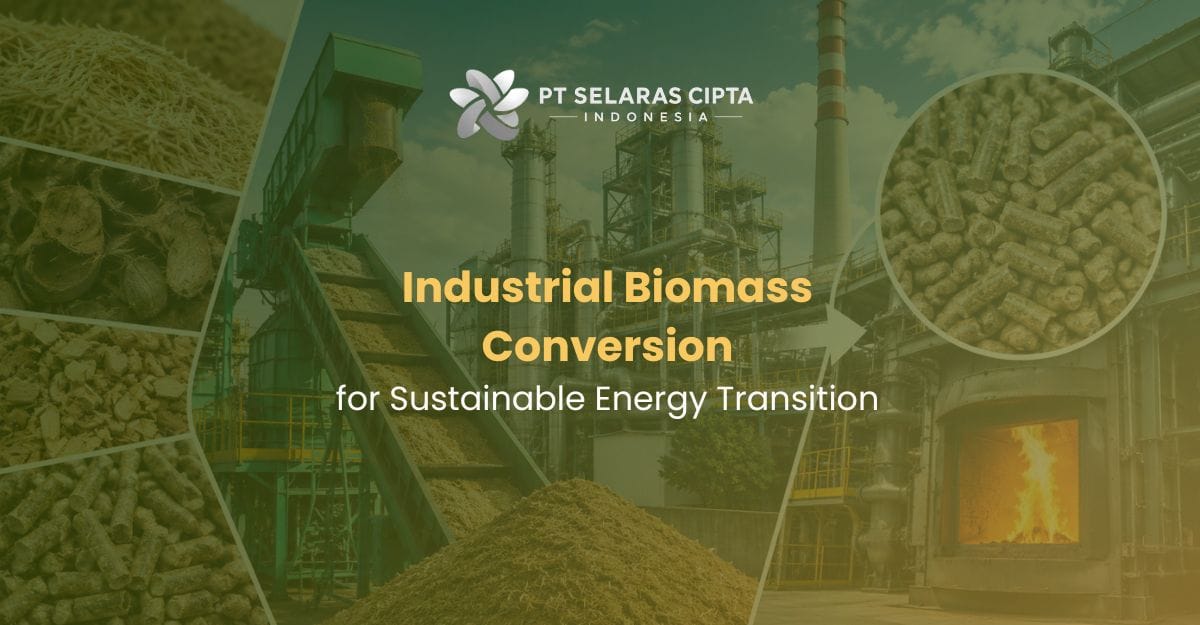
The global energy crisis continues reshaping industrial fuel strategies across many countries. Rising fossil fuel prices, supply chain instability, geopolitical tensions, and stricter environmental regulations have pushed industries to search for more sustainable energy alternatives. At the same time, governments continue accelerating decarbonisation programmes in order to reduce greenhouse gas emissions and improve long-term energy security.
Because of this situation, industrial biomass conversion has gained significant attention worldwide. Many manufacturers, power producers, and industrial boiler operators now utilise agricultural waste and organic biomass as renewable fuel sources. Instead of depending entirely on coal, fuel oil, or natural gas, industries increasingly integrate biomass into their energy systems to reduce operational costs and support sustainability targets.
Industrial biomass conversion refers to the process of transforming organic materials into usable industrial energy. Agricultural residues such as rice husk, palm kernel shell, wood waste, sugarcane bagasse, and sawdust can undergo processing into biomass fuel suitable for industrial combustion systems. In many cases, biomass conversion also improves waste management because industries and agricultural sectors can utilise materials that would otherwise become environmental burdens.
Moreover, biomass conversion continues expanding because renewable fuel demand keeps increasing globally. Co-firing projects, biomass power plants, manufacturing facilities, and industrial heating systems now require stable biomass fuel supply in large quantities. Consequently, industries continue investing in biomass processing technologies that improve fuel consistency, transportation efficiency, and combustion performance.
Why Industrial Biomass Conversion Continues Expanding

The industrial sector consumes enormous amounts of energy every year. Traditionally, coal and fossil fuels dominated industrial heating systems because they offered relatively stable supply and high calorific value. However, environmental concerns and carbon reduction policies have gradually changed the situation.
Many countries now implement stricter emission standards for factories and power plants. Consequently, industries must reduce carbon emissions without sacrificing operational efficiency. Biomass conversion provides one of the most practical solutions because many industrial systems can integrate biomass fuel without requiring complete infrastructure replacement.
Furthermore, fossil fuel price volatility has increased procurement uncertainty for manufacturers. Coal and natural gas prices may fluctuate significantly due to geopolitical conflicts, transportation disruptions, or global supply shortages. Biomass, on the other hand, often offers more flexible regional sourcing opportunities, especially in agricultural countries with abundant organic waste resources.
Agricultural biomass also supports circular economy initiatives. Instead of burning agricultural waste openly or sending organic residues to landfills, industries can convert those materials into renewable energy. This approach not only reduces waste accumulation but also creates additional economic value for agricultural sectors.
In Asia particularly, rice husk and palm biomass continue attracting strong international demand. Countries with large agricultural industries produce substantial quantities of biomass residue every year, making industrial biomass conversion increasingly viable for both domestic and export markets.
Types of Biomass Used in Industrial Conversion
Different industries utilise various biomass materials depending on regional availability, combustion requirements, and fuel specifications. Agricultural biomass remains one of the most widely used categories because it offers relatively stable supply and competitive pricing.
Rice husk has become one of the most popular biomass materials in Asia. Rice milling operations generate large quantities of husk residue annually, allowing manufacturers to process the material into pellets or briquettes for industrial fuel applications. Properly processed rice husk pellets provide relatively stable combustion characteristics while supporting renewable energy programmes.
Palm kernel shell also continues gaining popularity because of its high calorific value and lower moisture content compared to several other agricultural residues. Many biomass power plants and industrial boilers utilise palm kernel shell for co-firing and direct combustion systems.
Meanwhile, wood waste such as sawdust, wood chips, and timber residues remains highly important within biomass conversion industries. Wood biomass generally offers good combustion efficiency when processed correctly. However, growing sustainability concerns have encouraged industries to increase utilisation of agricultural waste biomass instead of relying entirely on forest resources.
Sugarcane bagasse, corn waste, coconut shell, and food processing residues also contribute significantly to industrial biomass fuel production in several regions. As biomass conversion technologies continue improving, industries can utilise a broader range of organic materials more efficiently.
Industrial Biomass Conversion Technologies
Industrial biomass conversion involves several processing methods depending on fuel requirements and energy applications. Some industries prefer direct combustion systems, while others utilise advanced thermal conversion technologies.
Combustion remains the most common biomass conversion method. In this process, biomass fuel burns directly inside industrial boilers or combustion chambers to generate heat and steam. Many factories use combustion systems because they integrate relatively easily into existing industrial infrastructure.
Co-firing systems have also expanded rapidly in recent years. Rather than replacing coal entirely, co-firing blends biomass with coal during combustion. This method allows power plants and industrial boilers to reduce carbon emissions gradually without requiring full system replacement. Consequently, co-firing has become one of the fastest-growing biomass conversion strategies globally.
Besides direct combustion, gasification technology continues gaining industrial attention. Gasification converts biomass into synthetic gas or syngas through controlled thermal processing with limited oxygen supply. Industries can then use syngas for power generation or industrial heating applications.
Pyrolysis technology offers another advanced biomass conversion method. Through high-temperature thermal decomposition without oxygen, pyrolysis produces biochar, bio-oil, and combustible gases. Although pyrolysis systems require more complex infrastructure, the technology continues developing for future renewable energy applications.
Mechanical biomass processing also plays a major role in industrial fuel preparation. Before pelletising, biomass materials usually undergo drying and grinding stages to improve consistency. Lower moisture content improves combustion efficiency, while uniform particle size supports stable pellet production.
Pelletising itself significantly improves biomass handling efficiency. Biomass pellets possess higher density than loose organic materials, making transportation and storage more practical for industrial-scale procurement. In addition, uniform pellet dimensions improve feeding system performance inside industrial boilers.
Benefits of Industrial Biomass Conversion
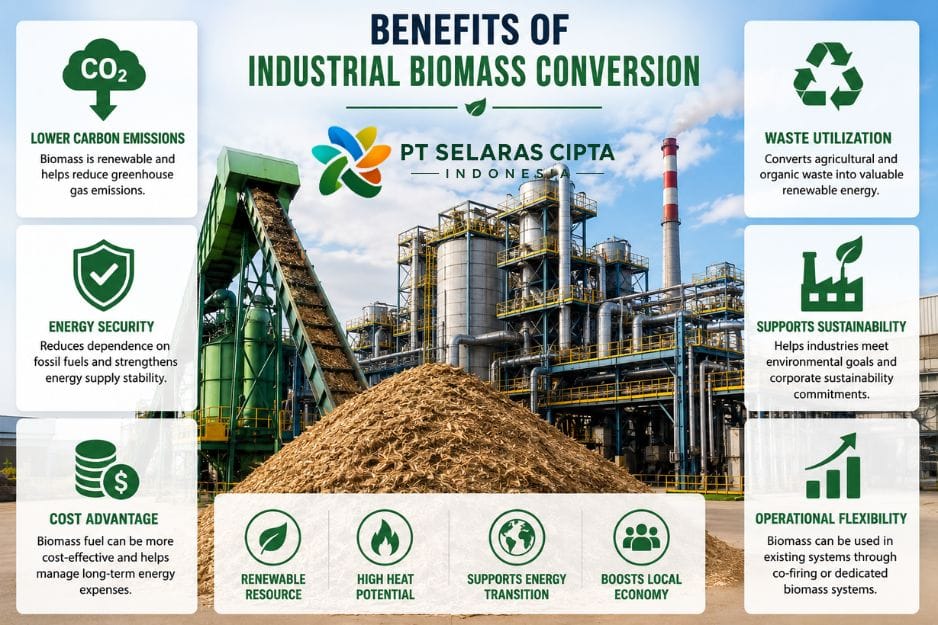
Industrial biomass conversion provides several important environmental and economic advantages. Firstly, biomass fuel helps reduce greenhouse gas emissions compared to traditional fossil fuels. Although biomass combustion still releases carbon dioxide, renewable biomass participates within shorter carbon cycles because plants absorb carbon during growth.
Secondly, biomass conversion supports energy diversification. Industries relying entirely on fossil fuels remain vulnerable to global market fluctuations and supply disruptions. By integrating biomass fuel into industrial operations, companies may improve long-term fuel security and operational flexibility.
Furthermore, agricultural biomass often offers cost advantages in regions with abundant farming activity. Instead of importing expensive fossil fuels, industries may utilise locally available agricultural residues for energy production. This approach can strengthen local economies while reducing waste disposal problems simultaneously.
Biomass conversion also creates additional commercial opportunities for agricultural sectors. Farmers and rice milling operations may generate additional income streams by supplying agricultural residues to biomass manufacturers and exporters.
Moreover, renewable fuel adoption increasingly improves corporate sustainability profiles. Many multinational companies now prioritise lower-carbon manufacturing processes as part of environmental, social, and governance commitments. Consequently, biomass conversion may strengthen competitiveness within international markets.
Procurement Strategy for Industrial Biomass Fuel
Large-scale biomass procurement requires careful supplier evaluation and technical assessment. Industrial buyers should never focus solely on pricing because inconsistent fuel quality may create serious operational problems later.
Firstly, buyers should request detailed technical specifications from potential suppliers. Important parameters usually include moisture content, ash content, calorific value, pellet durability, bulk density, and production capacity.
However, technical documentation alone remains insufficient for large procurement decisions. Therefore, trial shipments play a crucial role in industrial biomass purchasing strategies.
For procurement contracts involving thousands or tens of thousands of tonnes, buyers should ideally conduct one to three trial shipments before signing long-term agreements. Trial shipments allow industrial operators to evaluate actual combustion behaviour, ash generation, feeding performance, and storage conditions under real operational environments.
One shipment may help verify basic quality, while multiple trial shipments provide better insight into long-term consistency. In many cases, suppliers may achieve excellent results during initial production runs but struggle maintaining consistent quality over extended periods. Consequently, repeated testing often reduces procurement risk considerably.
Industrial buyers should also inspect supplier production facilities whenever possible. Factory visits often reveal manufacturing standards, raw material management practices, drying systems, storage conditions, and quality control procedures more clearly than technical documents alone.
Logistics capability deserves equal attention. Biomass fuel remains highly sensitive to moisture exposure during transportation and storage. Therefore, buyers should evaluate packaging systems, container loading methods, export handling procedures, and freight coordination before finalising supply agreements.
Storage and Handling Considerations
Proper storage management significantly affects biomass fuel quality after delivery. Even premium-quality biomass pellets may deteriorate rapidly under poor storage conditions.
Warehouses should maintain good ventilation while preventing excessive humidity and water exposure. Biomass materials absorb moisture relatively easily, which may reduce calorific value and weaken fuel durability over time.
Using pallets underneath biomass bags helps minimise direct contact with concrete floors and improves airflow circulation. Furthermore, warehouse operators should avoid excessive stacking pressure because pellet breakage may increase biomass dust formation.
Container preparation also influences biomass condition during international shipment. Professional exporters generally inspect containers carefully before loading to ensure dry internal conditions and proper structural integrity.
Packaging systems such as jumbo bags with protective liners often help reduce moisture penetration during sea transportation. Additionally, proper loading arrangements minimise pellet damage throughout long-distance export routes.
Future Outlook for Industrial Biomass Conversion
Industrial biomass conversion will likely continue expanding as global energy transition programmes accelerate further. Governments increasingly encourage renewable energy adoption through carbon reduction policies, emission regulations, and sustainability incentives.
Meanwhile, industries continue searching for practical methods to reduce fossil fuel dependency without compromising operational efficiency. Biomass conversion offers one of the most realistic transition pathways because many industrial systems can integrate renewable fuel gradually through co-firing or hybrid energy strategies.
Technological innovation may also improve biomass processing efficiency significantly over the coming years. Advanced drying systems, automated pelletising technology, and improved thermal conversion methods may increase fuel consistency and reduce operational costs further.
At the same time, international biomass trade may continue growing rapidly. Countries with abundant agricultural resources could become increasingly important suppliers within global renewable energy supply chains.
Conclusion
Industrial biomass conversion has become an increasingly important component of the global energy transition. Rising fossil fuel uncertainty, stricter environmental regulations, and growing renewable energy demand continue encouraging industries to adopt biomass fuel solutions for industrial heating, power generation, and co-firing applications.
Agricultural residues such as rice husk, palm kernel shell, wood waste, and organic by-products now play major roles within renewable industrial energy systems. Through proper processing, storage management, and logistics planning, biomass conversion can support cleaner industrial operations while improving long-term energy diversification.
For industrial buyers, selecting reliable biomass suppliers remains essential. Trial shipments, technical evaluations, production inspections, and logistics assessments all help reduce procurement risk before committing to large-scale contracts involving thousands or even tens of thousands of tonnes.
As renewable energy markets continue evolving, industrial biomass conversion will likely remain one of the most practical and scalable solutions for supporting sustainable industrial growth worldwide.