
The global energy sector continues shifting towards renewable fuel solutions as industries attempt to reduce carbon emissions and improve long-term energy security. Rising fossil fuel prices, stricter environmental regulations, and increasing demand for sustainable industrial operations have accelerated biomass utilisation across many countries. Industrial boilers, co-firing systems, manufacturing plants, and biomass power stations now require stable renewable fuel supply in increasingly large quantities.
Because of this situation, rice husk pellet quality standard for industrial use has become increasingly important among biomass suppliers, industrial buyers, and renewable energy operators. Fuel quality directly influences combustion efficiency, ash production, storage stability, transportation performance, and long-term operational cost.
Many industries initially focus on procurement pricing when purchasing biomass fuel. However, poor pellet quality may eventually create larger operational problems such as unstable combustion, excessive ash accumulation, feeding system disruption, increased maintenance frequency, and lower thermal efficiency. Consequently, industries should evaluate biomass quality standards carefully before committing to long-term procurement contracts.
Why Rice Husk Pellet Quality Standard Matters
Industrial biomass systems require stable fuel characteristics in order to maintain reliable combustion performance. Unlike fossil fuels with relatively standardised specifications, biomass fuel quality may vary significantly depending on raw material conditions, moisture management, production systems, and storage practices.
Consistent pellet quality supports more stable combustion inside industrial boilers and co-firing systems. Uniform biomass fuel also helps operators maintain predictable heat generation while reducing operational fluctuation.
On the other hand, inconsistent pellet quality may reduce thermal efficiency and increase fuel consumption unnecessarily. Wet pellets, excessive dust formation, and unstable density often create combustion instability during industrial operation.
Moreover, poor-quality biomass fuel may increase operational downtime. Excessive ash accumulation inside combustion chambers frequently requires more intensive cleaning procedures and maintenance schedules. In severe cases, clinker formation may disrupt boiler performance significantly.
Because of these operational risks, industrial biomass buyers increasingly prioritise long-term fuel consistency rather than focusing solely on lower procurement prices.
Main Parameters in Rice Husk Pellet Quality Standard
Several technical parameters determine whether rice husk pellets meet industrial biomass requirements. These specifications influence not only combustion performance but also storage stability, transportation efficiency, and boiler compatibility.
Moisture Content
Moisture content remains one of the most important factors in biomass fuel quality. Lower moisture generally improves combustion efficiency because less energy becomes wasted evaporating water during burning.
Excessive moisture may create unstable flame conditions and reduce calorific value considerably. Wet biomass also increases transportation weight unnecessarily, reducing overall fuel efficiency from a logistics perspective.
For industrial applications, properly controlled moisture content helps maintain more stable combustion performance and smoother boiler operation.
In addition, moisture management strongly affects storage stability. Biomass pellets naturally absorb humidity from surrounding environments, especially under poor ventilation conditions. Consequently, proper storage management remains essential after production and during shipment.
Ash Content
Rice husk naturally contains silica, which contributes to higher ash production compared to several other biomass materials. Because of this characteristic, ash content becomes one of the most critical technical parameters for industrial users.
Higher ash production does not automatically mean poor fuel quality. However, industrial operators must ensure that combustion systems and ash handling infrastructure can manage the fuel efficiently.
Boiler design plays a major role in determining how effectively rice husk pellets perform during combustion. Certain industrial systems can handle agricultural biomass very efficiently, while others may require more intensive cleaning schedules.
Excessive ash accumulation may increase maintenance frequency, reduce heat transfer efficiency, and create clinker formation under improper combustion conditions. Consequently, industries should evaluate ash behaviour carefully during fuel testing and trial shipments.
Calorific Value
Calorific value measures how much energy biomass fuel can generate during combustion. Higher calorific value generally improves fuel efficiency because industries require less biomass to produce the same amount of thermal energy.
Several factors influence rice husk pellet calorific value, including moisture content, pellet density, raw material quality, and manufacturing consistency.
Stable calorific performance remains extremely important for industrial boilers and co-firing systems because operational efficiency depends on predictable fuel behaviour. Sudden variation in energy output may affect steam production, thermal consistency, and overall manufacturing performance.
Consequently, industrial buyers often prioritise suppliers capable of maintaining consistent calorific specifications across long-term supply agreements.
Pellet Density and Durability
Pellet density significantly affects transportation efficiency, storage management, and fuel handling performance. Dense pellets occupy less storage volume and generally withstand transportation pressure more effectively.
Uniform pellet dimensions also improve feeding system performance inside industrial boilers. Irregular pellet sizes or fragile pellets may increase dust accumulation and feeding instability during combustion operations.
Durability therefore becomes another important quality indicator. Weak pellets frequently break during transportation, loading, unloading, and storage handling.
Excessive biomass dust may create operational inefficiency while increasing housekeeping requirements around industrial fuel systems. Because of this, professional biomass manufacturers usually implement screening and cooling processes to improve pellet structural stability before shipment.
Rice Husk Pellet Physical Specifications
Industrial buyers generally evaluate rice husk pellets using both physical specifications and laboratory-tested technical analysis. Consistent specifications help maintain reliable combustion performance, smoother handling, and more stable industrial operation.
| Physical Specifications | Details |
|---|---|
| Raw Material | Rice Husk |
| Pellet Diameter | 6–8 mm |
| Moisture Content | ≤ 12% (Low Moisture) |
| Calorific Value | High Energy Output |
| Ash Content | Controlled |
| Application | Industrial Boilers & Biomass Systems |
Specifications may vary depending on production batch and customer requirements.
The physical specifications above demonstrate why properly manufactured rice husk pellets remain suitable for industrial biomass systems and co-firing applications. Low moisture levels help improve combustion efficiency, while controlled pellet sizing supports smoother feeding system performance.
Lab Tested Technical Analysis
Besides physical specifications, laboratory analysis also plays an important role in determining industrial biomass quality. Technical testing helps industrial buyers evaluate combustion characteristics, ash behaviour, sulfur content, and overall fuel performance more accurately.
| Parameter | Standard (ASTM Method) | adb | ar | daf |
|---|---|---|---|---|
| Ash Content, % | ASTM D 3174-12 | 14.24 | 16.79 | 15.12 |
| Volatile Matter, % | ASTM D 3175-20 | 66.27 | 58.10 | 52.42 |
| Fixed Carbon, % | By Calculation | 19.48 | 17.11 | 15.45 |
| Total Sulfur, % | ASTM D 4239-18 | 0.04 | 0.02 | 0.01 |
| Gross Calorific Value (kcal/kg) | ASTM D 5865-13 | 3,588 | 3,068 | 2,767 |
| Chlorine (Cl), % | ASTM D 4208-18 | 0.19 | 0.17 | 0.15 |
Low sulfur and chlorine content remain particularly important for industrial combustion systems because they may help reduce corrosion risk and environmental impact. Meanwhile, stable volatile matter and fixed carbon levels contribute to more predictable combustion behaviour during industrial operation.
The calorific value also demonstrates that rice husk pellets can support industrial heating systems and biomass fuel applications effectively when combustion systems are properly configured.
Production Factors Affecting Pellet Quality
Rice husk pellet quality depends heavily on manufacturing consistency. Even high-quality raw materials may produce poor fuel performance when processing conditions remain uncontrolled.
Drying represents one of the most important production stages. Proper drying reduces excessive moisture while preparing biomass for stable pellet formation. Uneven drying may create inconsistent combustion behaviour and weaker pellet durability.
Grinding also influences pellet consistency considerably. Uniform biomass particle size supports smoother pelletising performance and more stable density throughout production.
During pelletising itself, compression pressure and temperature directly affect pellet structure. Proper compression improves density and durability while supporting smoother industrial handling.
Cooling systems then help stabilise pellet structure after compression. Without sufficient cooling, pellets may crack or deteriorate more easily during transportation and storage.
Finally, screening systems remove excessive biomass dust and broken particles before packaging. This process helps improve shipment cleanliness and operational performance during industrial use.
Rice Husk Pellet Quality Standard for Export Markets
Consistent Quality Remains Essential for Export
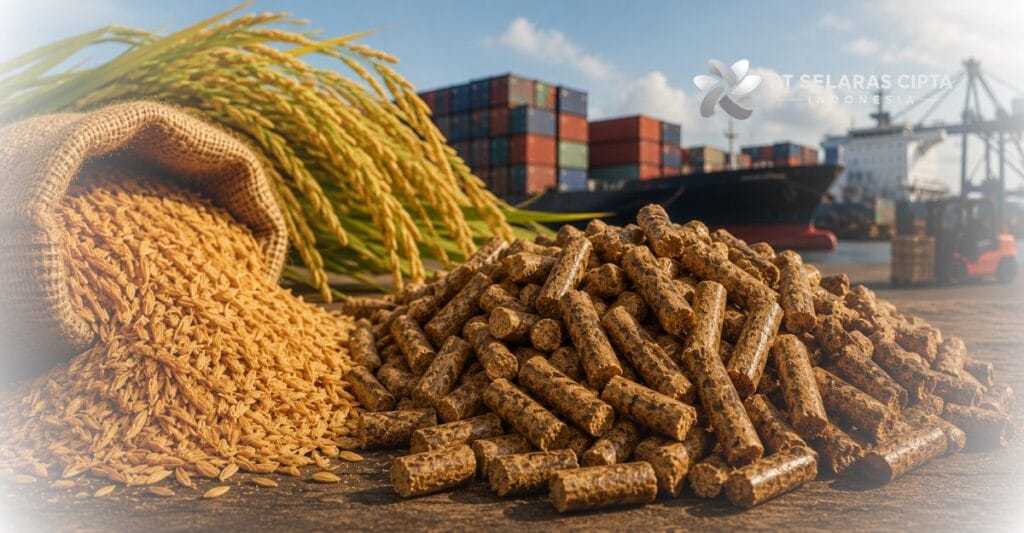
Industrial export buyers usually prioritise stable pellet specifications because inconsistent biomass quality may disrupt large-scale operations. Long-term biomass contracts therefore require reliable fuel performance across repeated shipments.
Trial Shipments Help Verify Fuel Performance
Many industrial buyers conduct one to three trial shipments before finalising bulk procurement agreements. Trial shipments help evaluate combustion behaviour, ash handling, and operational compatibility under real industrial conditions.
Choosing Reliable Rice Husk Pellet Suppliers
Selecting the right supplier remains equally important as evaluating fuel specifications themselves. Industrial biomass procurement requires long-term reliability, especially for projects involving thousands or tens of thousands of tonnes annually.
Professional suppliers should maintain stable production systems, proper quality control procedures, and sufficient manufacturing capacity for continuous supply agreements.
Buyers should also evaluate technical transparency carefully. Reliable suppliers generally provide clear technical specifications covering moisture content, ash level, calorific value, pellet density, and production capability.
Whenever possible, industrial buyers should inspect production facilities directly. Factory visits often reveal manufacturing standards, raw material handling practices, storage conditions, and operational consistency more clearly than technical documentation alone.
Logistics capability also deserves close attention because delayed shipments may disrupt industrial production schedules significantly.
Read more: Selecting Best Rice Husk Pellet Supplier for Bulk Export
Industrial Biomass Quality Supports Long-Term Efficiency
As renewable energy adoption continues expanding globally, biomass fuel quality will become increasingly important for industrial energy systems. Stable biomass specifications help industries improve combustion efficiency, reduce operational disruption, and maintain more predictable long-term fuel performance.
Rice husk pellets continue gaining international attention because agricultural biomass offers strong renewable energy potential while supporting circular economy initiatives. However, fuel quality consistency remains essential for achieving reliable industrial performance.
Proper moisture management, controlled ash levels, stable calorific value, good pellet durability, and professional manufacturing standards all contribute significantly to successful biomass utilisation.
Industries planning long-term biomass procurement should therefore prioritise technical evaluation, supplier reliability, and operational compatibility rather than focusing solely on lower pricing.
For companies seeking reliable rice husk pellet supply and industrial biomass solutions, contacting PT. Selaras Cipta Indonesia may help support renewable energy projects, co-firing systems, and long-term industrial biomass requirements.