
The global energy market continues facing major uncertainty as fossil fuel prices fluctuate across international markets. Coal, natural gas, and fuel oil costs have experienced repeated volatility over recent years due to geopolitical conflict, supply chain disruption, and increasing energy demand. At the same time, industries worldwide continue accelerating decarbonisation strategies in order to reduce carbon emissions and improve long-term energy sustainability.
Because of this situation, biomass fuel demand has increased considerably, especially for industrial boilers, co-firing systems, biomass power plants, and manufacturing operations. Among the most widely used biomass fuels today, rice husk pellets and wood pellets remain two of the most frequently compared options for industrial energy applications.
For many industrial operators, rice husk pellet vs wood pellet cost comparison has become an increasingly important topic when evaluating renewable fuel alternatives for long-term operations. Fuel cost alone, however, does not provide a complete picture. Moisture content, ash production, calorific value, storage stability, transportation efficiency, and boiler compatibility all influence long-term operational performance and overall energy cost.
Many industries initially focus on lower procurement prices, yet poor fuel selection may eventually increase maintenance expenses, combustion inefficiency, ash handling requirements, and operational downtime. Consequently, industrial buyers should evaluate both technical and economic factors carefully before selecting biomass fuel for large-scale operations.
Why Biomass Fuel Demand Continues Rising
Industries now face growing pressure to reduce fossil fuel dependency while maintaining operational efficiency. Governments across Asia, Europe, and other regions continue introducing stricter environmental regulations targeting industrial emissions and carbon reduction.
At the same time, many power plants and manufacturing facilities seek practical energy transition strategies without requiring complete infrastructure replacement. Biomass fuel provides one of the most realistic solutions because many industrial combustion systems can integrate renewable biomass with relatively minor modifications.
Co-firing programmes continue driving biomass demand further. Instead of eliminating coal entirely, many facilities now blend biomass fuel with coal to reduce carbon emissions gradually. This approach allows industries to transition towards renewable energy while maintaining operational reliability.
Agricultural waste biomass has gained particularly strong attention because it supports circular economy initiatives. Rather than becoming environmental waste, agricultural residues can undergo conversion into renewable industrial fuel. Consequently, rice husk pellets have become increasingly attractive in agricultural countries with large rice production industries.
Meanwhile, wood pellets continue dominating several international biomass markets because of their relatively stable combustion characteristics and lower ash content. However, rising wood demand and forestry sustainability concerns have encouraged many industries to compare agricultural biomass alternatives more seriously.
Understanding Rice Husk Pellet Characteristics
Rice husk pellets originate from rice milling residue generated during rice processing operations. Countries such as Indonesia, Vietnam, India, and Thailand produce enormous quantities of rice husk every year, making the material highly attractive for biomass conversion.
Manufacturers usually process rice husk through drying, grinding, pelletising, cooling, and screening stages before producing industrial-grade pellets. Proper manufacturing significantly improves fuel consistency, transportation efficiency, and storage handling compared to loose rice husk material.
One of the main advantages of rice husk pellets involves fuel cost competitiveness. Because rice husk comes from agricultural waste streams, raw material procurement often remains more affordable compared to wood biomass. This situation may provide substantial fuel cost savings for industries consuming thousands of tonnes annually.
Moreover, rice husk pellet production supports agricultural waste utilisation. Instead of disposing rice husk through open burning or landfill accumulation, industries can convert the residue into valuable renewable energy.
However, rice husk pellets also present several operational considerations. Ash content generally remains higher than wood pellets because rice husk naturally contains silica. Consequently, some industrial boilers may require more frequent ash handling and maintenance procedures when using rice husk biomass.
Boiler compatibility therefore becomes extremely important. Certain combustion systems handle higher ash biomass more efficiently, while others may experience clinker formation or increased maintenance requirements if fuel quality remains inconsistent.
Understanding Wood Pellet Characteristics
Wood pellets typically originate from sawdust, wood chips, timber waste, or forestry residues. Manufacturers compress dried wood particles into dense cylindrical pellets suitable for industrial and residential heating systems.
Wood pellets remain highly popular because of their relatively stable combustion behaviour. In many cases, wood pellets provide higher calorific value and lower ash production compared to agricultural biomass pellets. Consequently, many industrial users prefer wood pellets for applications requiring cleaner combustion conditions.
Lower ash production also helps reduce maintenance frequency for industrial boilers and combustion chambers. Ash disposal costs may therefore remain lower over long-term operations.
In addition, wood pellets often demonstrate strong combustion consistency because wood fibre composition remains relatively stable under controlled manufacturing processes. Uniform pellet density and lower moisture content may improve feeding system performance as well.
Nevertheless, wood pellet pricing may fluctuate significantly depending on forestry supply conditions, export demand, transportation cost, and environmental regulations related to wood sourcing. In some international markets, wood pellet prices have increased substantially because of rising renewable energy demand.
Furthermore, large-scale wood pellet production sometimes raises sustainability concerns related to forest resource management. As a result, several industries now evaluate agricultural biomass alternatives more actively as part of renewable fuel diversification strategies.
Rice Husk Pellet vs Wood Pellet Cost Comparison
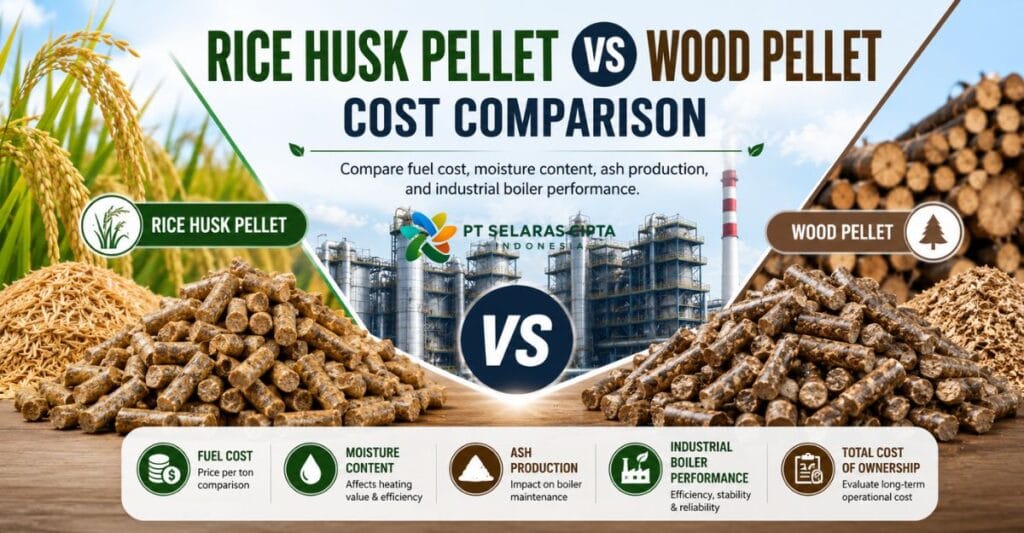
Before selecting biomass fuel for industrial operations, buyers should compare both fuels from technical and economic perspectives rather than focusing only on procurement price.
| Comparison Factor | Rice Husk Pellet | Wood Pellet |
|---|---|---|
| Raw Material Source | Agricultural waste from rice milling | Sawdust, wood chips, forestry residue |
| Average Fuel Cost | Usually lower in agricultural regions | Often higher depending on wood supply |
| Calorific Value | Moderate | Higher and more stable |
| Ash Content | Higher due to silica content | Lower ash production |
| Boiler Maintenance | May require more ash handling | Usually lower maintenance frequency |
| Moisture Sensitivity | Requires proper storage management | Also sensitive but often more stable |
| Combustion Stability | Depends on boiler compatibility | Generally more stable |
| Sustainability Aspect | Supports agricultural waste recycling | Depends on sustainable forestry management |
| Availability in Asia | Very abundant in rice-producing countries | Depends on forestry industry capacity |
| Industrial Application | Co-firing, industrial boilers, biomass fuel | Biomass power plants, heating systems |
| Storage Requirement | Dry warehouse with good ventilation | Similar controlled storage conditions |
| Long-Term Procurement | Competitive for bulk industrial supply | May fluctuate with export demand |
The comparison above shows that rice husk pellets often provide stronger pricing advantages, especially in countries with large rice industries and abundant agricultural residue. Industries prioritising lower fuel cost and circular economy benefits may therefore consider rice husk biomass an attractive renewable fuel option.
On the other hand, wood pellets generally offer cleaner combustion performance, lower ash generation, and more stable calorific value. Consequently, industries requiring lower maintenance frequency may prefer wood biomass despite potentially higher procurement cost.
Ultimately, the best fuel choice depends heavily on boiler design, operational priorities, fuel availability, storage infrastructure, and long-term procurement strategy.
Rice Husk Pellet vs Wood Pellet for Industrial Boiler Efficiency
Industrial boiler efficiency remains one of the most important factors when comparing biomass fuel performance. Although fuel pricing often becomes the main focus during procurement discussions, combustion stability and boiler compatibility may create even greater long-term operational impact.
Rice husk pellets and wood pellets both support renewable industrial heating systems, yet each fuel behaves differently during combustion. Rice husk pellets generally produce higher ash because of their silica content. Consequently, some boiler systems may require more frequent ash removal and cleaning procedures.
However, several modern industrial boilers can handle agricultural biomass efficiently when combustion systems and air flow configurations are properly adjusted. In many cases, industries prioritising lower fuel cost may still achieve favourable operational efficiency using rice husk pellets despite higher ash generation.
Wood pellets, meanwhile, often provide more stable combustion characteristics and lower ash accumulation. Because of this advantage, wood pellets may reduce maintenance frequency and improve combustion consistency within certain industrial heating systems.
Nevertheless, boiler efficiency does not depend solely on fuel type. Moisture content, pellet density, feeding system design, combustion chamber configuration, and operator experience all influence thermal performance significantly.
Therefore, industries should evaluate biomass fuel based on actual operational compatibility rather than assuming one fuel automatically performs better under every condition.
Rice Husk Pellet vs Wood Pellet Sustainability and Environmental Impact
Sustainability considerations continue influencing industrial fuel decisions as renewable energy policies expand globally. Many companies now evaluate biomass fuel not only from economic perspectives but also from environmental and long-term resource management viewpoints.
Rice husk pellets offer strong circular economy advantages because they utilise agricultural waste generated during rice milling operations. Instead of becoming landfill waste or open-burn residue, rice husk can undergo conversion into renewable industrial fuel. This approach helps reduce agricultural waste accumulation while supporting biomass energy development simultaneously.
Furthermore, countries with large rice industries can often maintain stable raw material supply without requiring additional land clearing specifically for biomass production. Consequently, rice husk pellets may provide stronger sustainability benefits in agricultural regions.
Wood pellets, on the other hand, continue raising environmental debate in several international markets. Sustainable forestry management remains possible when manufacturers utilise sawdust, timber residue, and certified forestry by-products responsibly. However, concerns sometimes emerge when rising biomass demand contributes to deforestation pressure or excessive logging activity.
Because of this situation, many industries now assess biomass sourcing transparency more carefully before entering long-term procurement agreements. Buyers increasingly prefer suppliers capable of demonstrating responsible raw material sourcing and sustainable biomass production practices.
Ultimately, both biomass fuels can support renewable energy transition goals when industries prioritise sustainable sourcing, efficient combustion systems, and long-term environmental responsibility.
Read also: Selecting Best Rice Husk Pellet Supplier for Bulk Export
Which Biomass Fuel Is Better?
There is no universal answer regarding whether rice husk pellets or wood pellets perform better because industrial requirements vary considerably between applications.
Rice husk pellets may provide stronger economic advantages in agricultural regions with abundant rice production and competitive biomass supply chains. Industries prioritising lower procurement cost and agricultural waste utilisation may prefer rice husk biomass systems.
Wood pellets, meanwhile, may suit industries requiring cleaner combustion performance, lower ash handling, and more stable calorific value.
Ultimately, fuel selection should depend on several operational factors, including:
- Boiler design compatibility
- Fuel availability
- Long-term procurement stability
- Maintenance capability
- Sustainability targets
- Transportation infrastructure
- Storage conditions
Industries should therefore evaluate biomass fuel strategically rather than focusing solely on short-term fuel pricing.
Conclusion
Rice husk pellet vs wood pellet cost comparison involves far more than basic fuel pricing. Moisture content, ash production, calorific value, combustion stability, maintenance requirements, logistics management, and long-term procurement reliability all influence total operational efficiency.
Rice husk pellets often provide competitive pricing and strong agricultural sustainability advantages, especially in rice-producing regions. Meanwhile, wood pellets generally offer lower ash production and more stable combustion characteristics for certain industrial applications.
As global industries continue accelerating renewable energy adoption and decarbonisation programmes, both biomass fuels will likely remain important components of industrial energy transition strategies.
For industrial operators managing large-scale procurement annually, technical evaluation, supplier assessment, and trial shipments remain essential before committing to long-term biomass fuel contracts, feel free to contact us.