
Selecting the best rice husk pellet supplier has become increasingly important as global biomass demand continues rising rapidly. Not every supplier can maintain consistent pellet quality, reliable export schedules, or sufficient production capacity for large-scale procurement contracts.
Some suppliers only operate on a small scale, while industrial buyers may require thousands or even tens of thousands of tonnes every month. Therefore, selecting the best rice husk pellet supplier involves much more than simply comparing prices.
Buyers must evaluate manufacturing standards, raw material availability, export capability, storage management, logistics systems, and long-term production reliability before signing procurement agreements.
Why Rice Husk Pellets Continue Gaining Global Attention
The global energy crisis continues to reshape industrial fuel markets across many regions. Over the past few years, coal prices have fluctuated sharply, while natural gas supply disruptions have increased operational uncertainty for manufacturers and power producers.
At the same time, governments and private industries continue accelerating the transition towards lower-emission energy sources in order to reduce carbon footprints and improve long-term energy security.
As a result, biomass demand has risen considerably, particularly for rice husk pellets. Industries such as textile manufacturing, food processing, industrial boilers, cement plants, and biomass power stations increasingly rely on alternative fuels that offer both sustainability and cost efficiency. Furthermore, co-firing projects in coal-fired power plants continue expanding across Asia and Europe, creating substantial demand for agricultural biomass products in bulk quantities.
The renewable energy transition has significantly accelerated biomass consumption worldwide. Many industries now face stricter environmental regulations regarding emissions and fossil fuel usage.
Consequently, companies continue searching for cleaner fuel alternatives that can integrate into existing combustion systems without requiring major infrastructure changes.
Rice husk pellets offer several advantages in this situation
Firstly, rice husk itself is an agricultural by-product generated in massive quantities throughout rice-producing countries. Instead of becoming waste, the material can undergo processing into a valuable renewable fuel. Secondly, rice husk pellets support circular economy initiatives because they utilise agricultural residue rather than virgin wood resources.
Moreover, many co-firing projects prefer agricultural biomass due to its lower procurement cost compared to wood pellets. Several power plants now blend biomass with coal to reduce carbon emissions while maintaining operational stability. Because of this trend, industrial-scale rice husk pellet procurement continues growing steadily each year.
At the same time, buyers increasingly prioritise fuel consistency. Industrial boilers and biomass power systems require stable combustion characteristics in order to maintain efficiency.
Poor-quality pellets often create excessive ash accumulation, unstable flame conditions, or feeding system disruptions. Consequently, selecting a reliable supplier becomes a critical operational decision rather than merely a purchasing activity.
Characteristics of the Best Rice Husk Pellet Supplier
A professional supplier should demonstrate consistent quality control throughout the entire production process. Premium rice husk pellets do not originate solely from good raw materials. Instead, manufacturers must carefully manage drying, grinding, pelletising, cooling, screening, and packaging operations to ensure uniform product performance.
Moisture content remains one of the most important technical factors. Lower moisture levels generally improve combustion efficiency and calorific value while reducing smoke generation during burning. Excessive moisture, on the other hand, often decreases boiler performance and increases transportation weight unnecessarily.
Similarly, ash content plays a major role in industrial applications. High ash levels may increase maintenance frequency for combustion systems and create operational inefficiencies. Therefore, experienced suppliers usually conduct routine quality inspections before shipment.
Pellet density and uniform sizing also deserve close attention. Consistent pellet dimensions improve feeding system performance and support smoother combustion inside industrial boilers. In contrast, irregular pellet sizes often create unstable burning conditions and excessive biomass dust.
Besides product quality, buyers should also evaluate production capacity carefully. Some suppliers may produce excellent pellets but lack the infrastructure necessary for large-scale export commitments.
Suppliers located near major rice milling regions generally possess stronger long-term production stability because raw material transportation becomes more efficient and less vulnerable to supply disruptions.
Industrial procurement contracts often require continuous monthly deliveries ranging from several thousand tonnes to tens of thousands of tonnes. Consequently, suppliers must maintain strong raw material networks and scalable manufacturing systems.
How to Determine the Best Rice Husk Pellet Supplier for Large-Scale Import Requirements
Importing rice husk pellets in bulk quantities requires a far more detailed procurement strategy than small-scale biomass purchasing. Buyers should conduct technical, operational, and logistical evaluations before entering long-term agreements.
Firstly, buyers should request detailed technical specifications from multiple suppliers. Important parameters typically include:
- Moisture content
- Ash content
- Calorific value
- Bulk density
- Pellet diameter
- Durability
- Production capacity
However, technical documents alone should never become the sole basis for supplier selection. Some suppliers may provide laboratory results that fail to represent actual large-scale production quality. Therefore, trial shipments remain extremely important.
For industrial procurement projects involving thousands of tonnes, buyers should ideally conduct at least one to three trial shipments before finalising long-term contracts.
Smaller trial shipments allow buyers to evaluate actual combustion performance, ash behaviour, feeding stability, and handling conditions under real operational environments.
In many cases, a single trial shipment may not fully represent long-term production consistency. Because of this, conducting multiple trial shipments over different production periods often provides a more accurate assessment of supplier reliability.
For example:
- One trial shipment may reveal basic product quality.
- Second trial shipments can help evaluate consistency.
- Third trial shipments generally provide stronger confidence for long-term procurement agreements.
The trial shipment volume itself depends on operational requirements. Some buyers begin with container-scale orders, while larger industrial operators may test several hundred tonnes before scaling procurement further.
Additionally, buyers should inspect the supplier’s manufacturing facility whenever possible. Factory visits often reveal operational standards that cannot appear within technical documents alone. Production cleanliness, raw material handling, storage conditions, drying systems, and quality control procedures all provide valuable insight into long-term reliability.
Logistics and Export Readiness Matter Significantly
Even high-quality rice husk pellets may become problematic if logistics systems remain poorly managed. Biomass products remain highly sensitive to moisture exposure during storage and transportation. Consequently, export preparation becomes equally important as manufacturing quality.
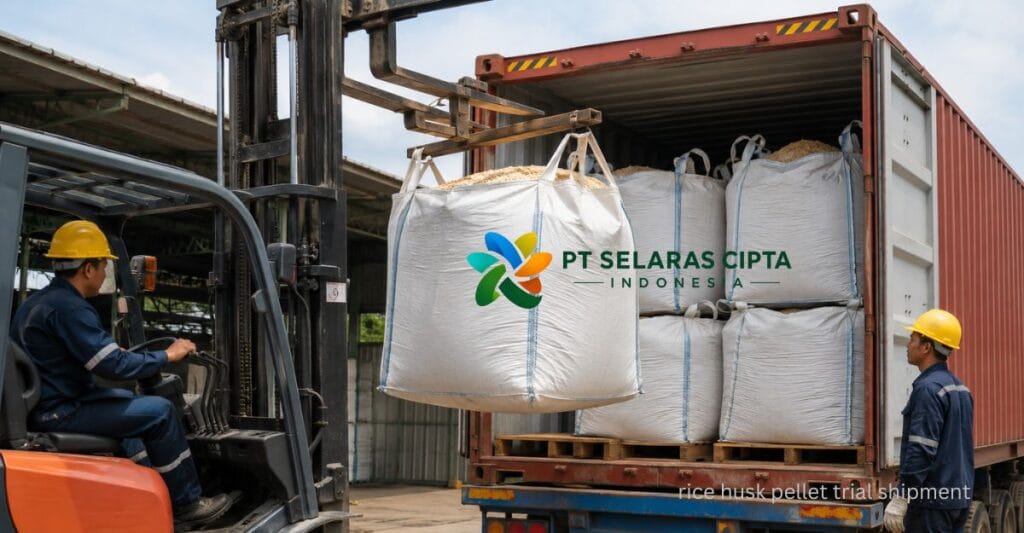
Professional suppliers typically use proper packaging systems such as jumbo bags combined with plastic liners to reduce moisture penetration during shipment. Furthermore, containers should undergo inspection before loading to ensure dry internal conditions.
Container loading methods also influence pellet condition upon arrival. Poor loading practices may increase pellet breakage and generate excessive biomass dust during transit. Therefore, experienced exporters usually implement systematic loading procedures in order to maintain product integrity throughout international shipping routes.
Shipping reliability also deserves close attention. Industrial buyers often operate under strict production schedules, meaning delayed biomass deliveries can disrupt manufacturing operations or power generation activities. Consequently, buyers should evaluate supplier relationships with freight forwarders, port accessibility, and export handling experience before committing to large contracts.
Storage Guidance for Rice Husk Pellets
Proper storage management remains essential after shipment arrival. Even premium-quality pellets may deteriorate rapidly if stored incorrectly.
Firstly, biomass pellets should remain protected from excessive humidity and direct water exposure. Warehouses should maintain adequate ventilation while preventing rain penetration and condensation build-up. Placing pellets directly on concrete floors should also be avoided because moisture transfer may gradually damage pellet quality.
Using pallets underneath jumbo bags helps minimise direct floor contact and improves airflow circulation around stored biomass. Additionally, warehouse stacking arrangements should allow sufficient air movement while preventing excessive pressure on lower pellet layers.
Temperature stability also plays an important role. Extremely poor ventilation may increase internal heat accumulation inside storage facilities, potentially affecting biomass quality over time.
Long-term storage without proper monitoring may increase moisture absorption, reduce calorific value, and weaken pellet durability. Therefore, industrial buyers should implement routine storage inspections as part of their biomass fuel management strategy.
For more information, read also: Rice Husk Pellet Storage Guide for Industrial Biomass
Indonesia Continues Attracting Global Biomass Buyers
Indonesia continues gaining attention as a major rice husk pellet supplier because of its enormous agricultural resources. The country produces substantial quantities of rice annually, generating abundant rice husk availability for biomass manufacturing.
Moreover, Indonesia offers relatively competitive production costs compared to several other biomass-exporting countries. Combined with expanding export infrastructure and increasing biomass investment, Indonesian suppliers continue strengthening their position within international renewable energy markets.
Several industrial buyers also favour Indonesian biomass because of shorter shipping routes to many Asian markets. As regional co-firing programmes continue expanding, demand for Indonesian rice husk pellets may increase even further in the coming years.
Ready to Deal with One of The Best Rice Husk Pellet Supplier from Indonesia?
Selecting the best rice husk pellet supplier requires careful technical evaluation, procurement planning, and long-term operational consideration. While pricing remains important, industrial buyers should prioritise consistency, production capacity, export readiness, logistics management, and quality control standards before finalising procurement agreements.
For large-scale imports involving thousands or tens of thousands of tonnes, trial shipments remain highly recommended. Conducting one to three trial shipments often provides valuable insight into actual product performance and supplier reliability before entering long-term biomass contracts.
As global energy markets continue shifting towards renewable alternatives, reliable rice husk pellet suppliers will play an increasingly important role in supporting industrial decarbonisation, biomass power generation, and sustainable fuel transition worldwide.
Feel free to contact our export sales today (with Bima) to discuss your inquiry.